- LASIK can typically treat nearsightedness up to -12.00 diopters, farsightedness up to +6.00 diopters and astigmatism up to 6.00 diopters.
- SMILE can typically treat nearsightedness up to -10.00 diopters and astigmatism up to 5.00 diopters, but it cannot treat farsightedness.
- Your prescription is only part of the picture: corneal thickness, corneal shape, prescription stability and age all affect candidacy.
- If your prescription is too high for laser vision correction, EVO ICL (-3.00 to -20.00 diopters) and Refractive Lens Exchange (RLE) are proven alternatives.
- A comprehensive consultation is the only way to confirm which procedure is right for your eyes.
LASIK (Laser Assisted In Situ Keratomileusis) and SMILE (Small Incision Lenticule Extraction) are laser vision correction procedures that reshape the cornea to correct refractive errors. Although both reshape the cornea, they use different methods and suit different circumstances. Both can correct nearsightedness (myopia) and astigmatism, but SMILE is not suitable for farsightedness (hyperopia).
Each procedure has its own prescription limits. However, suitability also depends on other factors, including corneal thickness and curvature, prescription stability and age. If your prescription is too high for laser correction, other solutions are available, such as the Implantable Collamer Lens (ICL) and Refractive Lens Exchange (RLE).
How High Is Too High? Standard Diopter Limits for LASIK vs SMILE
A diopter is the unit used to measure the focusing power needed to correct your vision. A negative number indicates nearsightedness and a positive number indicates farsightedness. The higher the number, the greater the correction needed to restore clear vision.
The standard maximum treatment limits for each procedure are:
| Refractive Error | LASIK Limit | SMILE Limit |
|---|---|---|
| Nearsightedness (myopia) | Up to -12.00 diopters | Up to -10.00 diopters |
| Farsightedness (hyperopia) | Up to +6.00 diopters | Not treatable |
| Astigmatism | Up to 6.00 diopters | Up to 5.00 diopters |
ZEISS SMILE is generally considered a strong option for patients with high nearsightedness and those prone to dry eyes. LASIK, by contrast, handles a wider range of refractive errors, including farsightedness.
Beyond the Prescription: Why Corneal Thickness and Shape Matter Most
A high prescription can make laser surgery unsuitable, but the prescription only measures how light focuses on the retina. The cornea is the clear, dome-shaped front surface of the eye, and it provides most of the eye’s focusing power. As a result, corneal thickness and shape are critical factors in determining whether you are a suitable candidate.
Why these factors matter:
- Corneal shape: A healthy cornea is normally smooth and symmetrical. An irregular shape can cause blurred and distorted vision.
- Corneal thickness: Laser surgery reshapes the cornea by removing tissue. If the cornea is too thin, its structural integrity could be compromised.
- Corneal health: An abnormally shaped and thin cornea can indicate an underlying disease that rules out laser surgery.
LASIK vs SMILE vs PRK: Treatment Capabilities Breakdown
The three main laser refractive surgery procedures each reshape the cornea in a different way:
- LASIK: A femtosecond laser creates a thin flap in the cornea, an excimer laser reshapes the tissue underneath, and the flap is then put back in place. Wavefront LASIK is one advanced form of this procedure.
- SMILE: A flapless procedure that removes a small piece of corneal tissue through a tiny incision.
- PRK (Photorefractive Keratectomy): The outer layer of the cornea is removed, the surface is reshaped, and a bandage contact lens is applied until the outer layer grows back.
All three can correct varying degrees of nearsightedness and astigmatism, while LASIK and PRK can also correct farsightedness.
| Feature | LASIK | SMILE | PRK |
|---|---|---|---|
| Corneal flap | Yes | No (small incision) | No (surface treatment) |
| Treats nearsightedness | Yes | Yes | Yes |
| Treats astigmatism | Yes | Yes | Yes |
| Treats farsightedness | Yes | No | Yes |
| Recovery speed | Fastest | Fast | Slowest, with more discomfort |
| Best suited to | A wide range of prescriptions | High nearsightedness and dry eye concerns | Thin corneas and active or high-impact sports |
Recovery from LASIK is quickest, while PRK recovery is slowest and can cause the most discomfort. However, PRK is often more suitable for patients with thin corneas and those who take part in active or high-impact sports.
Options for High Prescriptions: Why EVO ICL Might Be Your Best Choice
For patients whose prescriptions are too high for laser surgery, EVO ICL may be the best option. EVO ICL is a lens-based procedure that places a custom, biocompatible lens inside the eye. It does not remove corneal tissue or reshape the cornea, which makes it ideal for people with thin corneas.
Key benefits of EVO ICL include:
- Correction of severe nearsightedness, from -3.00 to -20.00 diopters, as well as astigmatism.
- Built-in UV protection.
- Suitability for people who are prone to dry eyes.
- Reversibility, since the lens can be removed or exchanged.
To be a candidate, you generally need:
- A stable prescription for at least one year.
- Sufficient space inside the eye to house the lens.
- To be between 21 and 60 years old.
Can Surgery Still Work if You Have Severe Astigmatism or Farsightedness?
Extreme cases may require alternatives to standard laser surgery, but several options are available for people with severe astigmatism or farsightedness:
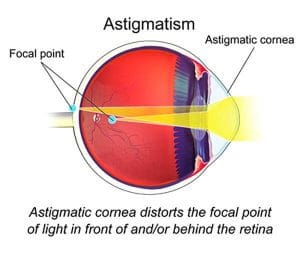
- LASIK, PRK and SMILE: These reshape the cornea and can correct astigmatism up to 4 to 6 diopters, and farsightedness up to +6.00 diopters (except SMILE). All depend on sufficient corneal thickness.
- EVO ICL: This implants a Collamer lens and is suitable for people with high prescriptions and thin corneas.
- Refractive Lens Exchange (RLE): Refractive Lens Exchange replaces the eye’s natural lens and is suitable for people with very high prescriptions, severe astigmatism, or those over 55 years old.
Whichever procedure you consider, your prescription should be stable for at least a year. Regular astigmatism is also easier to treat than irregular astigmatism, such as the irregular astigmatism caused by keratoconus.
How to Find Out Your True Eligibility at IQ Laser Vision
IQ Laser Vision offers an online self-test that gives you a preliminary indication of whether you are a suitable candidate for vision correction. The self-test is intended only as a guide, so you can also book a free consultation with one of our eye doctors for a comprehensive assessment.
During your consultation, our clinical team will:
- Assess your vision.
- Measure your corneal shape and thickness.
- Evaluate your prescription stability and overall eye health.
- Review your general medical history.
- Discuss your lifestyle and visual goals.
This full evaluation allows our team to recommend the treatment that is best for you. For further independent reading on laser vision correction, the American Academy of Ophthalmology provides a helpful patient overview.
Frequently Asked Questions
What is the highest prescription LASIK can correct?
LASIK can typically correct nearsightedness up to -12.00 diopters, farsightedness up to +6.00 diopters and astigmatism up to 6.00 diopters. However, the prescription alone does not determine candidacy. Corneal thickness, corneal shape, prescription stability and age must also be assessed during a comprehensive eye examination.
Can SMILE correct farsightedness?
No, SMILE cannot correct farsightedness. SMILE is designed to treat nearsightedness up to -10.00 diopters and astigmatism up to 5.00 diopters. Patients with farsightedness may be better suited to LASIK or PRK, which can correct farsightedness up to +6.00 diopters, or to a lens-based procedure such as Refractive Lens Exchange.
What are the options if my prescription is too high for laser eye surgery?
If your prescription is too high for laser eye surgery, EVO ICL and Refractive Lens Exchange are the main alternatives. EVO ICL places a lens inside the eye and corrects nearsightedness from -3.00 to -20.00 diopters. Refractive Lens Exchange replaces the natural lens and suits very high prescriptions or patients over 55.
Why does corneal thickness matter for LASIK and SMILE?
Corneal thickness matters because LASIK and SMILE correct vision by removing corneal tissue. If the cornea is too thin, removing tissue could compromise its structural integrity. A thin or abnormally shaped cornea can also indicate an underlying disease, so patients with thin corneas are often better suited to PRK or EVO ICL.