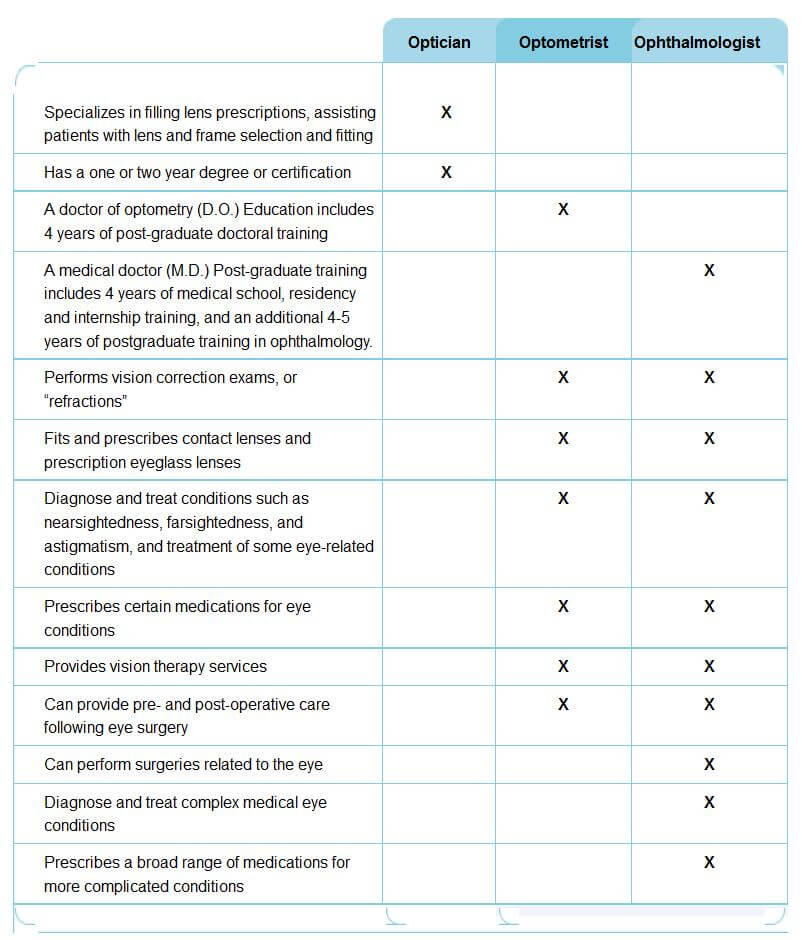
The first step in the quest for 20/20 vision was to read up on the available options for vision correction. You can’t completely rely on the information you find online, so a professional is typically recommended. But is a regular eye doctor, the one that checks your vision every year, enough? Apparently not. There are a variety of eye care specialists out there and here’s a breakdown for you:
The Optometrist. The optometrist that you see each year usually checks your vision to see how bad it’s gotten since your last visit. They can also see you for any minor vision issues. Like if you have a sty, suffer from dry eyes or get an eye infection and things of that nature. They write a prescription for your vision so you can get either contacts or glasses or both. The education typically involved with being an optometrist is a 4-year college with a degree in the sciences. Then another 4 years post grad professional training in optometry school. Of course the education requirements can differ from state to state. Optometrist are also referred to as ODs, and as a doctor. They are required to fulfill continuing education credits each year to keep their license to practice and stay current on medical issues.
An Optician. An optician is similar to that of a pharmacist, except instead of fulfilling drug prescriptions. They take the vision prescription your eye doctor prescribes and fits you, the patient, in contacts or glasses.
The Ophthalmologist. This is where vision correct matters most. You want to be sure you see a reputable ophthalmologist for your vision correction needs. Ophthalmologists do everything that an optometrist does and more. Similar to what optometrists go through in their educational requirements. Ophthalmologists complete a 4-year college in the sciences, 4 years of med school, 1 year of internship to get their doctorate. Then they are required to complete a minimum of 3 years of residency in their special field (glaucoma, cataract, refractive procedures, etc). In this instance, we would want to seek out an ophthalmologist who specializes in refractive procedures, or vision correction. It’s easiest to think of ophthalmologists as someone who takes on serious vision or eye health issues. Typically cases that may involve surgeries. An optometrist may check your vision and eyes for routine care. But if they notice something more serious, they would refer you to an ophthalmologist. An ophthalmologist would then diagnose a patient’s case and manage a treatment plan. This may occur through medication or surgery.
Many ophthalmologists and optometrists work hand in hand through a partnership known as co-management. On your next routine eye exam with your optometrist and you see flyers and pamphlets about LASIK. Under co-management partnerships, an optometrist may discover something serious with your vision or overall eye health. They will refer you to see an ophthalmologist to undergo treatment, medically or surgically. After the condition are surgically treated by an ophthalmologist. You would go back to your optometrist for follow-up visits and they would continue to monitor your recovery and progress. This is also referred to as post-op care.
The reason I researched the differences between all these types of eye doctors was because I was getting different advice from my regular optometrists that I see every year to a LASIK center who only let me speak with what appears to be a salesperson with no medical background other than the experience they had working at the center (for who knows how long). Finally I discovered that the best way to get a straight and reliable answer was to visit a reputable LASIK clinic https://www.iqlaservision.com/our-services/that offered both an optometrist and ophthalmologist on site to exam my eyes and tell me if I was a good candidate for LASIK. Yes, you read that right, not everyone should undergo LASIK and a good doctor will tell you upfront that you are not a good candidate for LASIK. For now, my optometrist had told me I was not a good candidate because my cornea was thin, but lo and behold, I went to see an ophthalmologist who was able to refer me to a LASIK clinic that specialized in thin cornea patients. I love my optometrist but sometimes you need a higher level of expertise when it comes to surgery and more complicated medical issues.
What I’ve discovered is that if you are serious about getting LASIK, it’s best to seek advice from an ophthalmologist. By going to the source they can provide you with the correct information related to your vision and overall eye health before advising you against or for surgery.