


LASIK
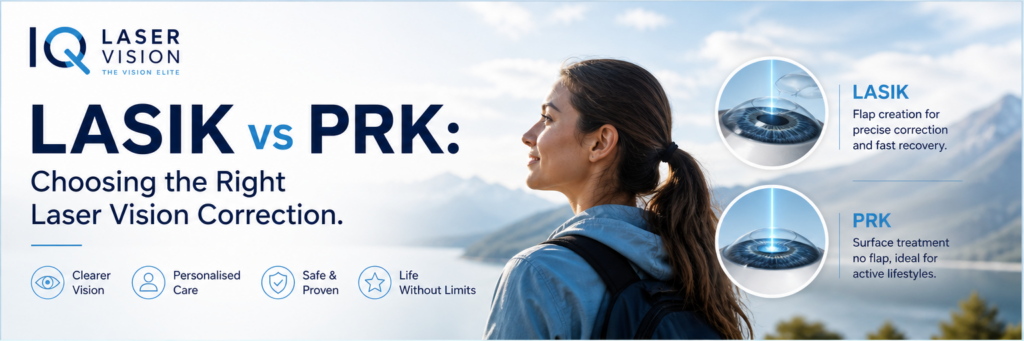
LASIK vs PRK Eye Surgery: Choosing the Right Laser Vision Correction
The key difference: LASIK creates a thin corneal flap to reach and reshape the tissue underneath. PRK removes the cornea’s thin outer layer, called the epithelium, and creates no flap. Recovery: LASIK recovery is much faster, and most patients see…
Read More
LASIK
SMILE vs LASIK: Which Laser Eye Surgery Is Right for You?
LASIK creates a corneal flap to reshape the eye. SMILE is flap-free and removes a lenticule from inside the cornea through a tiny incision. LASIK treats a broader range of refractive errors, including myopia, hyperopia and astigmatism. SMILE is primarily…
Read More

LASIK
Is There an Age Limit for LASIK?
The only age requirement for LASIK, per the FDA, is that you must be at least 18 years old. There is no upper age limit. Candidacy depends on a stable prescription, healthy eyes and good overall health. The most common…
Read More

Articles
How Much Does LASIK Cost in Los Angeles & California?
LASIK cost in Los Angeles ranges from $1,500 to $4,000 per eye, averaging around $3,000 per eye, or $3,000 to $8,000 for both eyes. San Francisco and Bay Area pricing tends to run higher than Los Angeles, while Orange County…
Read More

Articles
LASIK Cost in Houston: What to Expect & How to Save
LASIK cost in Houston typically ranges from about $1,750 to $2,800 per eye, which is generally 20 to 40 percent lower than comparable procedures in California. Your final price depends on your prescription, corneal thickness, the laser technology used, and…
Read More

LASIK
LASIK vs. Cataract Surgery: Can You Have Both?
LASIK vs. Cataract Surgery: Understanding the Differences and Compatibility Many people who have undergone LASIK eye surgery to correct their vision in their younger years wonder if they can still have cataract surgery later in life. The answer is YES!…
Read More

Articles
How Much Does Refractive Lens Exchange (RLE) Cost in Los Angeles?
Refractive Lens Exchange (RLE) is an increasingly popular vision correction procedure, particularly for patients over 40 or those seeking a permanent alternative to glasses and contact lenses. One of the most common questions we hear is: how much does refractive…
Read More

SMILE
7 Myths About SMILE Laser Eye Surgery & Real Patient Reviews
SMILE has been FDA approved since September 2016 and is backed by hundreds of clinical studies as a safe, effective alternative to LASIK. SMILE cannot guarantee you will never need glasses again, but most patients gain lasting freedom from daily…
Read More

PRK
FAQs About Wearing Contacts
How do contacts work? Contacts serve the same purpose as eyeglasses: helping you see more clearly. These lenses “stick” to the surface of your eye so they can move with your eyeball. This allows your vision to stay clear and…
Read More

Articles
Understanding My Vision
Over half the population in the United States experiences one or more common visual acuity problems. Generally, people with visual acuity problems are nearsighted, farsighted, and/or have astigmatism. Collectively, these conditions are medically referred to as lower order aberrations. Lower order aberrations are usually corrected by wearing glasses, contact lenses or by laser vision correction.
Read More