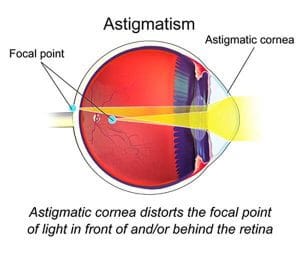
Eyeglasses and contact lenses have been the traditional route for dealing with eyesight problems. But in the last 25 years or so, laser treatments have made vast inroads to creating better eyesight for millions of people. There are treatment options that include LASIK, PRK, Lasek, and even inserting artificial lenses permanently into the eye. The laser eye treatments usually are procedures to reshape the curvature of the cornea, so light enters the eye in the correct way for “perfect” vision.
In the early days of laser treatment for eye surgery (back in the 1980s). The procedure was known as Radial Keratotomy (RK) which was used for treating nearsightedness. But there were side effects, especially long-term ones that left a lot to be desired.
Then came Photorefractive Keratectomy (PRK), which received FDA approval in 1995 and continues to be used with success. In this procedure, they use the laser to remove tissue to correct the curve of the cornea. Though it is still an option, it is less common as well as less popular than LASIK eye vision correction. But for those with chronic dry eye syndrome, PRK may be a good option. It is also a better option for those who have extra thin corneas.
LASIK surgery’s big advantage is that there is almost no pain. Or discomfort during the healing process immediately after the surgery. Vision also usually clears and corrects faster with LASIK surgery. You should understand that there is more than one type of LASIK surgery. The differences are what type of flap is cut into the the thin cover over the cornea (epithelium).
Bladeless LASIK Surgery
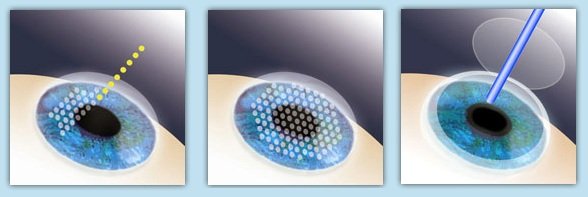
Bladeless LASIK surgery skips the use of the microkeratome (blade). And uses a femtosecond laser to create the flap before shaping the cornea as needed. This procedure is also referred to as iLASIK, zLASIK, and VisuMax.
For Lasek surgery(note the “ek” rather than the “ik”), an extra thin hinged flap is cut. And alcohol is used on the eye’s surface to move the flap out of the way during the laser reshaping of the cornea.
Epi-LASIK surgery uses a special cutting tool when lifting the flap. But other than that is much the same as Lasek surgery.
Wavefront surgery can be done for either LASIK or PRK surgeries. And uses the newest type of analysis known as “wavefront” for best accuracy on how light travels through the eye. Excimer lasers have built-in wavefront options. Studies indicate that when wavefront analysis is used. There is less likely to be night vision problems and glare issues after the surgery.
Conductive Keratoplasty (CK) was approved initially by the FDA in 2002. And is generally used as a corrective procedure after LASIK or cataract surgeries. A tiny probe emits low heat radio waves placed around the eye surface’s periphery.
Additional Treatment Options
In addition to the above types of surgery, there are also treatments to insert corrective lenses into the eye, known as Implantable Lenses (Visian ICL and Verisyse), approved in 2004 by the FDA. Refractive Lens Exchange (RLE), which is similar to cataract surgery but in RLE the natural lens is not cloudy. Though it is removed and replaced with an artificial lens shaped to correct farsightedness. And there is also cataract surgery, which is probably the only one of the surgeries that is covered by Medicare. This, like RLE, removes the natural lens and either scrapes it clean or replaces it with an implanted artificial lens.
Are you considering some type of corrective eye surgery? We at www.iqlaservision.com/ can provide answers to your questions about laser treatments for eyesight correction.