- Advanced LASIK surgery uses high-resolution eye mapping, femtosecond lasers, and real-time tracking systems to deliver greater precision than traditional LASIK.
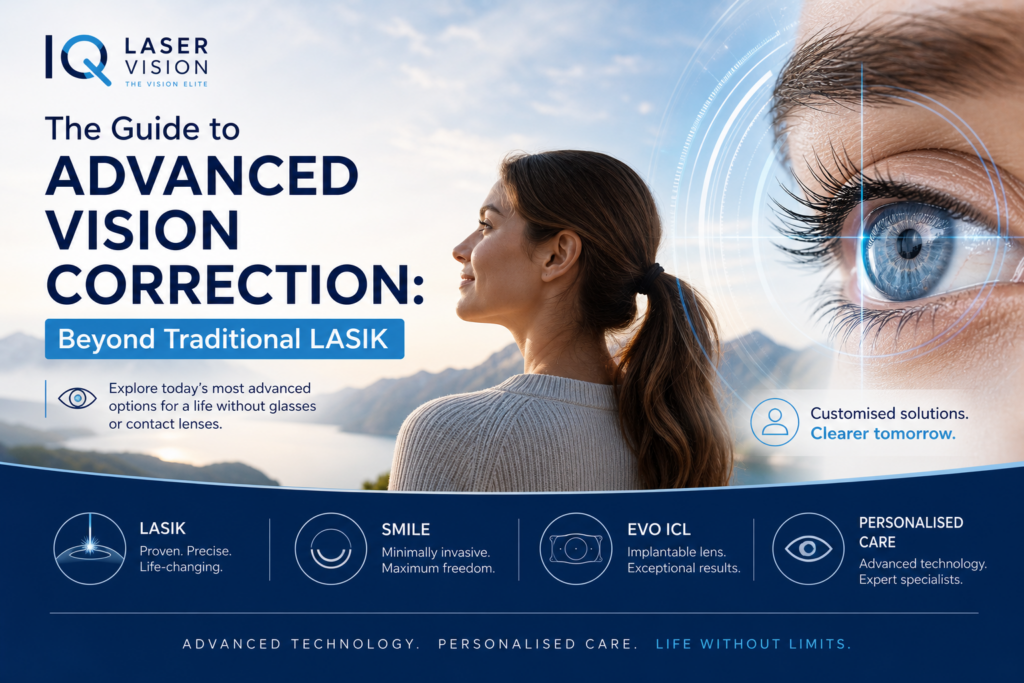
- Modern laser eye surgery procedures include SMILE, Custom Wavefront LASIK, and EVO ICL, each suited to different prescriptions, corneal profiles, and lifestyle needs.
- Custom Wavefront technology creates a detailed 3D map of your eye’s optical system, enabling highly personalised corrections that go beyond a standard prescription.
- EVO ICL is a reversible, cornea-sparing alternative for patients with high prescriptions or thin corneas who are not suitable for laser-based procedures.
- A comprehensive eye examination is essential to determine which advanced vision correction procedure is right for your eyes and lifestyle.
For decades, LASIK has been the go-to solution for people looking to reduce their dependence on glasses or contact lenses. While traditional LASIK remains a highly effective option, advancements in technology have significantly transformed the landscape of vision correction. Today, patients have access to a range of innovative procedures that go beyond the limitations of earlier techniques, offering greater precision, customisation, and outcomes.
Modern vision correction is no longer a one-size-fits-all solution. It is a highly personalised process that accounts for your unique eye structure, prescription, and lifestyle. From refined laser techniques to implantable lenses, the latest advancements in advanced LASIK surgery and modern laser eye surgery are reshaping how people achieve lasting, clear vision.
In this guide, we explore what sets advanced vision correction apart from traditional approaches, the key benefits it offers, and the leading procedures available today.
What is Advanced LASIK Surgery?
Advanced LASIK surgery refers to the evolution of traditional LASIK through the integration of newer technologies and more precise diagnostic tools. While the core principle remains the same, reshaping the cornea to improve how light focuses on the retina, advanced LASIK enhances every stage of the process.
Key technological improvements that define advanced LASIK include:
- High-resolution eye mapping: Detailed imaging of the eye allows surgeons to create a fully customised treatment plan, targeting subtle visual imperfections that a standard correction would not address.
- Femtosecond laser flap creation: Replacing the mechanical blade used in early LASIK procedures, femtosecond lasers create the corneal flap with significantly greater precision, consistency, and safety.
- Advanced tracking systems: Modern laser platforms incorporate real-time eye tracking that adjusts for even the smallest involuntary eye movements during treatment, ensuring accuracy throughout the procedure.
Together, these innovations contribute to sharper visual outcomes, improved safety profiles, and faster recovery times compared to earlier generations of laser eye surgery.
The Benefits of Advanced Vision Correction Surgery
Advanced vision correction surgery offers several meaningful advantages over traditional approaches:
- Greater precision: Detailed pre-operative measurements allow surgeons to deliver corrections that are more accurate and tailored than ever before, reducing the likelihood of residual refractive error.
- Fewer visual side effects: Personalised treatment plans lower the risk of post-operative visual disturbances such as glare, halos, and reduced contrast sensitivity, particularly at night.
- Improved safety: Technological advancements have significantly reduced the risk of complications compared with earlier procedures.
- Faster recovery: Many modern procedures are minimally invasive, resulting in less disruption to the eye and a quicker return to daily activities. Some patients notice improved vision within hours; others experience steady improvement over several days.
- Wider patient eligibility: Newer procedures such as SMILE and EVO ICL have extended the reach of vision correction to patients who were previously not suitable candidates for standard LASIK.
You can explore the specific technologies we use at IQ Laser Vision on our technology page.
SMILE: The Next Frontier in Modern Laser Eye Surgery
SMILE (Small Incision Lenticule Extraction) is one of the most significant developments in modern laser eye surgery. It is defined as a minimally invasive, flap-free procedure in which a femtosecond laser creates a small, lens-shaped piece of tissue called a lenticule within the cornea. This lenticule is then removed through a tiny incision of 4mm or less, gently reshaping the cornea and correcting vision without the need to create a large corneal flap.
Key advantages of SMILE eye surgery include:
- Preservation of greater corneal structural integrity compared to LASIK
- Reduced disruption to corneal nerves, leading to lower dry eye risk
- No flap means no flap-related complications, making it well suited to active patients and athletes
- Particularly effective for patients with myopia (nearsightedness) and mild astigmatism
SMILE represents a meaningful step forward in the evolution of laser vision correction, offering a less invasive alternative with strong, consistent clinical outcomes.
Custom Wavefront Technology: Personalising Your Vision
Custom Wavefront technology is one of the most impactful advancements in advanced laser eye surgery. Rather than applying a standard refractive correction based on your glasses prescription alone, wavefront-guided treatment analyses how light travels through the entire optical system of your eye.
Wavefront mapping produces a detailed, three-dimensional image of your eye’s optical characteristics, enabling surgeons to identify higher-order aberrations, subtle imperfections that affect visual quality beyond simple short-sightedness or astigmatism, including issues with contrast sensitivity, sharpness, and night vision performance.
By incorporating this data into the surgical plan, Custom Wavefront LASIK delivers a highly personalised correction. Patients often describe the results as “HD vision,” a level of clarity that standard prescriptions cannot reliably achieve. This approach is particularly beneficial for:
- Patients with complex or high prescriptions
- Those who have experienced visual disturbances with glasses or contact lenses
- Individuals seeking the highest possible quality of post-operative vision
EVO ICL: An Advanced Alternative for High Prescriptions
While laser-based procedures are highly effective for many patients, they are not suitable for everyone. For those with high prescriptions, thin corneas, or significant dry eye concerns, EVO ICL (Implantable Collamer Lens) offers a compelling alternative.
EVO ICL is defined as a procedure in which a thin, flexible biocompatible lens is placed inside the eye, positioned behind the iris and in front of the natural lens, without removing or reshaping any corneal tissue. Key benefits include:
- Wide prescription range: EVO ICL can correct levels of myopia that fall outside the safe treatment limits of LASIK or SMILE.
- Corneal preservation: Because the corneal surface is left untouched, EVO ICL is suitable for patients with thin or irregular corneas.
- Lower dry eye risk: With no corneal flap and no disruption to corneal nerves, EVO ICL carries a significantly lower risk of post-operative dry eye symptoms.
- Reversibility: Unlike permanent corneal procedures, the EVO ICL implant can be removed or replaced if vision changes significantly or improved technology becomes available in the future.
For patients who are not suited to modern laser eye surgery, EVO ICL opens the door to effective, high-quality vision correction with excellent long-term outcomes. Patients considering multiple options may also wish to explore Refractive Lens Exchange (RLE) as a further alternative, particularly for those aged 45 and over.
Is Advanced Vision Correction Surgery Right for You?
Determining whether advanced vision correction is right for you begins with a comprehensive eye examination. The most important factors include:
- Prescription strength and stability: Your prescription should have been stable for at least one to two years before surgery is considered.
- Corneal thickness and shape: This largely determines whether a corneal laser procedure such as LASIK or SMILE is appropriate, or whether an internal procedure like EVO ICL is more suitable.
- Overall eye health: Pre-existing conditions including dry eye, glaucoma, or irregular corneal topography must be assessed and discussed.
- Lifestyle and expectations: Your daily activities, occupation, and personal vision goals all play a role in identifying the most appropriate treatment path.
While advanced procedures can significantly improve vision, it is important to have realistic expectations. A qualified eye care professional will help you understand what outcomes are achievable based on your individual circumstances. Our vision correction self-test is a helpful starting point, and you can read real patient experiences on our testimonials page before booking a consultation with one of our ophthalmologists.
For authoritative clinical guidance on laser vision correction, the American Academy of Ophthalmology provides comprehensive and trusted patient resources.
The Future of Sight: Investing in Advanced Vision Correction
The future of vision correction is focused on continued innovation and increasingly personalised care. As technology advances, procedures are becoming more precise, less invasive, and accessible to a broader range of patients.
Artificial intelligence and next-generation imaging systems are expected to further enhance pre-operative treatment planning, enabling even greater levels of customisation. New techniques and devices continue to be developed that expand the possibilities of what vision correction can achieve.
Investing in advanced vision correction surgery is not simply about improving how you see today. It is about enhancing your quality of life for years to come. Clear, stable vision improves daily convenience, supports greater independence, and contributes meaningfully to overall wellbeing. To take the first step, contact IQ Laser Vision and book your personalised consultation.
Frequently Asked Questions
What is the difference between traditional LASIK and advanced LASIK surgery?
Traditional LASIK applies a standardised correction based on a basic prescription measurement. Advanced LASIK surgery uses high-resolution wavefront mapping, femtosecond laser technology, and real-time eye tracking to create a fully customised treatment plan. This results in greater precision, fewer visual side effects, and often a higher quality of post-operative vision.
What is the most advanced laser eye surgery available today?
Several procedures represent the leading edge of modern laser eye surgery, including SMILE (Small Incision Lenticule Extraction), Custom Wavefront LASIK, and EVO ICL for patients unsuitable for corneal laser treatment. The most advanced option for any individual depends on their prescription, corneal profile, and clinical suitability, which is determined through a comprehensive pre-operative assessment.
Who is a good candidate for advanced vision correction surgery?
Good candidates are generally adults with a stable prescription, adequate corneal thickness, and good overall eye health. Advanced procedures such as SMILE and EVO ICL have expanded eligibility to include patients with thin corneas, high prescriptions, or dry eye concerns who were not previously suitable for standard LASIK. A thorough consultation with an ophthalmologist is the only reliable way to determine your candidacy.
Is advanced vision correction surgery permanent?
Corneal laser procedures such as LASIK and SMILE produce permanent changes to the cornea that cannot be reversed. EVO ICL, however, is reversible: the implanted lens can be removed or replaced if needed. All procedures can be affected by natural age-related changes to the eye over time, such as presbyopia, which is unrelated to the surgery itself.