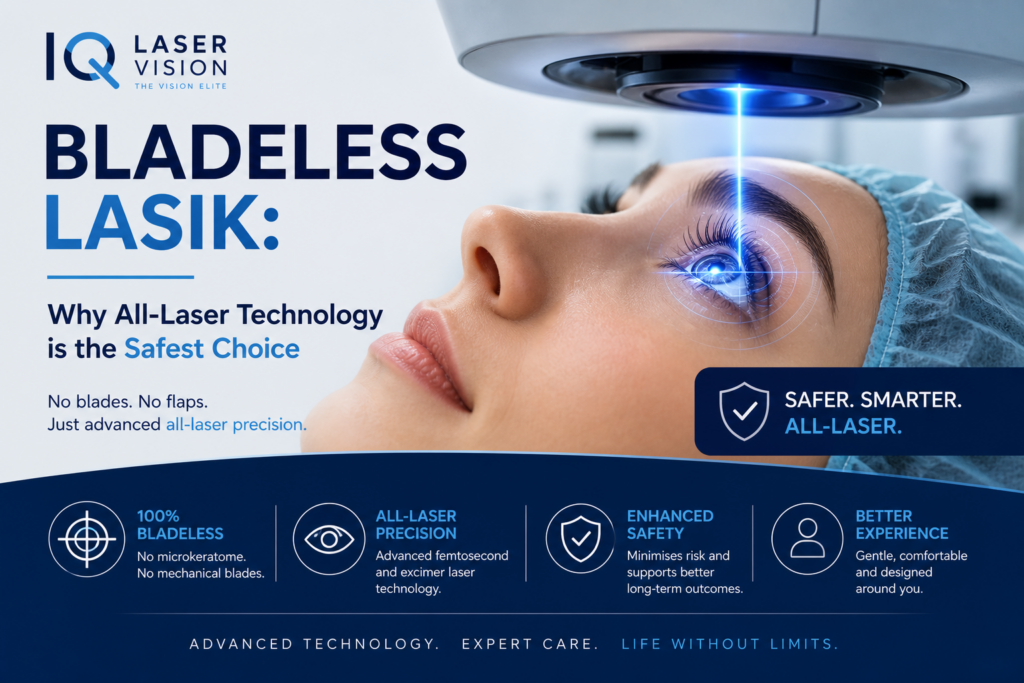
- Bladeless LASIK, also called all-laser LASIK, replaces the mechanical blade used in traditional LASIK with a femtosecond laser to create the corneal flap.
- Femtosecond laser technology operates at extraordinarily fast speeds, enabling more precise, predictable, and customisable flap creation than a mechanical blade can achieve.
- By eliminating blade-related risks such as irregular or incomplete flaps, bladeless laser eye surgery offers an improved safety profile over conventional LASIK.
- Custom flap creation promotes faster, more comfortable healing and contributes to sharper, more consistent long-term visual outcomes.
- A comprehensive pre-operative consultation at IQ Laser Vision determines your candidacy and ensures a fully personalised treatment plan.
Laser vision correction has come a long way since its early days, evolving into one of the safest and most precise medical procedures available today. Among these advancements, bladeless LASIK, also known as all-laser LASIK, has emerged as a leading option for patients seeking improved vision with enhanced safety and accuracy.
While traditional LASIK has delivered excellent results for millions of patients worldwide, newer technologies have refined the process even further. Bladeless laser eye surgery replaces the mechanical blade used in earlier procedures with advanced laser technology, offering a more controlled and customisable approach to corneal reshaping.
For patients exploring vision correction options, understanding the differences between traditional and bladeless LASIK is essential. From improved precision to a reduced risk profile, all-laser technology represents a meaningful step forward in modern eye care. This guide breaks down what makes bladeless LASIK a preferred choice and why it continues to gain traction among both patients and surgeons.
Traditional vs Bladeless LASIK: What You Need to Know
To understand the benefits of bladeless laser eye surgery, it helps to first understand how conventional LASIK works.
Traditional LASIK
In conventional LASIK, a surgeon creates a thin flap on the surface of the cornea using a mechanical device called a microkeratome, which contains a small oscillating blade. The flap is lifted so that an excimer laser can reshape the underlying corneal tissue, correcting how light is focused onto the retina. The flap is then repositioned and the eye begins healing immediately.
Bladeless LASIK
Bladeless LASIK follows the same general principle but replaces the microkeratome blade with a femtosecond laser to create the corneal flap. This difference may appear subtle, but it has a significant impact on the precision and predictability of the entire procedure. The laser allows for greater control over the thickness, shape, and diameter of the flap, reducing variability and improving consistency from patient to patient.
While traditional LASIK is still considered a safe and effective procedure, bladeless LASIK builds on that foundation by incorporating advanced technology to improve outcomes and further reduce surgical risk. You can learn more about the technology we use at IQ Laser Vision on our technology page.
Traditional vs Bladeless LASIK: Key Differences
| Feature | Traditional LASIK | Bladeless LASIK |
|---|---|---|
| Flap creation method | Mechanical microkeratome blade | Femtosecond laser |
| Flap precision | Good | Exceptional |
| Flap customisation | Limited | Highly customisable |
| Risk of irregular flap | Small but present | Significantly reduced |
| Real-time eye tracking | Variable | Advanced, integrated |
| Recovery comfort | Good | Often smoother |
| Visual outcome consistency | Good | High |
| Suitable for varied anatomy | Standard range | Greater personalisation |
The Precision of Femtosecond Lasers in Modern Surgery
At the core of bladeless laser eye surgery is the femtosecond laser, a highly sophisticated instrument that operates at extraordinarily fast speeds, measured in quadrillionths of a second. This level of precision allows surgeons to create corneal flaps with a degree of accuracy that a mechanical blade cannot replicate.
Rather than relying on physical contact and manual guidance, the femtosecond laser uses ultra-fast pulses of light to separate corneal tissue at a microscopic level. The result is a smoother, more predictable flap with well-defined, consistent edges. Key advantages of femtosecond laser precision include:
- Anatomy-specific customisation: Factors such as corneal thickness, curvature, and overall eye structure can be incorporated into flap design, enabling a truly personalised procedure.
- Reproducible accuracy: Because the laser is guided by advanced software, it delivers the same high standard of accuracy across every procedure, reducing the variability that can affect outcomes.
- Tissue-level control: The laser separates tissue without generating heat or physical force, minimising trauma to surrounding structures.
This combination of speed, precision, and customisability is why femtosecond laser technology is now considered the gold standard for flap creation in modern laser eye surgery.
Why All-Laser Technology Minimises Surgical Risks
Safety is the primary concern for any patient considering vision correction, and bladeless LASIK is specifically designed to address this. By eliminating the mechanical blade, the procedure reduces several risks associated with conventional flap creation.
In traditional LASIK, complications related to the microkeratome, such as irregular, incomplete, or buttonhole flaps, are rare but possible. Bladeless laser eye surgery significantly lowers the likelihood of these outcomes by creating precise, predictable flaps through a fully automated laser process. Additional safety advantages include:
- Controlled flap thickness: The laser allows for thinner, more uniform flaps that preserve greater corneal structural integrity, which is important for long-term eye stability.
- Real-time eye tracking: Advanced imaging and tracking systems continuously monitor eye movement during the procedure and make automatic micro-adjustments, ensuring the laser remains accurately aligned throughout treatment.
- Reduced physical trauma: With no blade making contact with the eye surface, the procedure is inherently less mechanically disruptive.
For patients who may be concerned about surgical risk, consulting with one of our experienced ophthalmologists can help clarify which procedure is most appropriate based on your individual eye profile. The American Academy of Ophthalmology also provides authoritative guidance on LASIK safety and patient selection.
The Benefits of Custom Flap Creation for Faster Healing
One of the most clinically significant advantages of bladeless laser eye surgery is the ability to create a highly customised corneal flap. This customisation directly influences both the effectiveness of the procedure and the quality of the recovery experience.
Because the femtosecond laser produces flaps with precise, individually tailored dimensions, surgeons can optimise the procedure to suit each patient’s unique corneal anatomy. The benefits of this tailored approach include:
- More natural flap repositioning: Smoother flap edges and uniform thickness allow the flap to settle back into position more naturally after surgery, promoting faster initial healing.
- Reduced surface disruption: A precisely designed flap causes less irritation to the surrounding corneal tissue, contributing to a more comfortable recovery.
- Improved long-term visual quality: By optimising every aspect of flap creation, bladeless LASIK helps patients achieve clearer, more consistent results over time.
Most patients notice significantly improved vision within one to two days following bladeless LASIK, in line with traditional LASIK recovery timelines. However, the enhanced precision of the flap often results in a smoother, more comfortable healing experience overall. If you would like to understand what recovery involves before committing, you can read about real patient journeys on our testimonials page.
Experience the Safety of Bladeless LASIK at IQ Laser Vision
Choosing where to have your procedure is just as important as choosing the procedure itself. At IQ Laser Vision, patients benefit from bladeless LASIK in a setting that combines state-of-the-art technology with experienced clinical care and a genuinely personalised approach.
Every patient begins with a comprehensive pre-operative consultation, during which a detailed evaluation determines your candidacy for bladeless laser eye surgery and informs a customised treatment plan. This ensures that every aspect of the procedure is tailored to your unique eye anatomy, prescription, and vision goals.
Our use of advanced all-laser technology allows surgeons to perform bladeless LASIK with a consistently high degree of precision and reliability. If you are also exploring other vision correction options, you may wish to review our pages on SMILE and EVO ICL as comparable modern alternatives, or take our vision correction self-test to begin assessing your suitability.
To find out whether bladeless LASIK is the right choice for your eyes, contact IQ Laser Vision today and take the first step toward clearer vision with confidence.
Frequently Asked Questions: Bladeless Laser Eye Surgery
What is bladeless LASIK and how does it differ from traditional LASIK?
Bladeless LASIK, also called all-laser LASIK, uses a femtosecond laser to create the corneal flap instead of the mechanical microkeratome blade used in traditional LASIK. This laser-based approach allows for greater precision, more customisable flap dimensions, and a reduced risk of blade-related complications such as irregular or incomplete flaps. The laser reshaping of the cornea that follows flap creation uses the same excimer laser technology in both procedures.
Is bladeless LASIK safer than traditional LASIK?
Bladeless laser eye surgery offers an improved safety profile compared to traditional LASIK. By replacing the mechanical blade with a femtosecond laser, the procedure eliminates certain risks associated with blade-based flap creation, including irregular flaps and microkeratome-related complications. Advanced real-time eye tracking systems further enhance safety by maintaining precise laser alignment throughout the procedure. Both procedures are considered safe, but bladeless LASIK represents a meaningful technological advancement.
How long does recovery take after bladeless LASIK?
Most bladeless LASIK patients notice significantly improved vision within 24 to 48 hours of their procedure. The customised flap created by the femtosecond laser often contributes to a smoother, more comfortable recovery experience compared to traditional LASIK. While individual healing times vary, most patients are able to return to normal daily activities within one to two days, with continued improvement in visual clarity over the following weeks.
Am I a suitable candidate for bladeless laser eye surgery?
Candidacy for bladeless LASIK depends on several factors, including corneal thickness and shape, prescription strength and stability, and overall eye health. A comprehensive pre-operative examination is the only reliable way to determine suitability. Patients who are not suitable for any form of LASIK may be candidates for alternative procedures such as SMILE, PRK, or EVO ICL. Our vision correction self-test is a helpful first step before booking a full consultation.