- LASIK reshapes the cornea using a laser; EVO ICL implants a thin collamer lens inside the eye without removing any corneal tissue.
- EVO ICL can correct a wider range of prescriptions, including moderate to severe myopia that falls outside LASIK’s safe treatment limits.
- Unlike LASIK, EVO ICL is reversible: the implanted lens can be removed or replaced if your vision changes or new technologies emerge.
- EVO ICL carries a significantly lower risk of dry eye symptoms compared to LASIK, which can disrupt corneal nerves during flap creation.
- LASIK is typically less expensive upfront, but EVO ICL may offer greater long-term value for patients who are not ideal LASIK candidates.
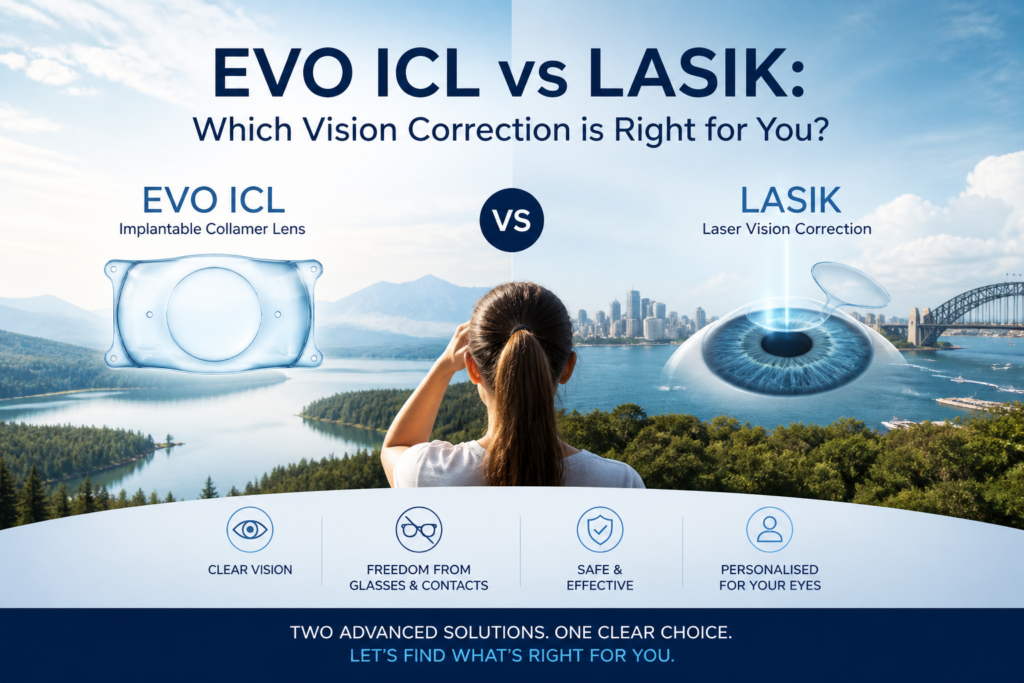
If you are considering vision correction surgery, you have likely come across two of the most popular options: EVO ICL and LASIK. Both procedures are designed to reduce or eliminate dependence on glasses and contact lenses, but they work in fundamentally different ways. Choosing the right option depends on multiple factors, including your prescription strength, eye health, corneal thickness, and long-term vision goals.
LASIK has been in widespread use for decades and is well regarded for its quick recovery and strong outcomes for mild to moderate prescriptions. EVO ICL is gaining significant popularity as a modern alternative, particularly for patients who are not suitable candidates for LASIK. Each procedure has its own benefits, risks, and clinical considerations. This guide breaks down the key differences between LASIK vs EVO ICL to help you make a confident and informed decision.
LASIK vs EVO ICL: Procedure Comparison Table
| Feature | LASIK | EVO ICL |
|---|---|---|
| How it works | Reshapes the cornea with a laser | Implants a lens behind the iris |
| Corneal tissue removed | Yes | No |
| Reversible | No | Yes |
| Prescription range | Mild to moderate | Mild to severe (wider range) |
| Suitable for thin corneas | Often not suitable | Yes |
| Dry eye risk | Moderate (temporary in most cases) | Low |
| Recovery time | 24 to 48 hours | Slightly longer than LASIK |
| Procedure duration | 10 to 15 minutes | 20 to 30 minutes |
| Upfront cost | Lower | Higher |
| Long-term flexibility | Limited (permanent corneal change) | High (lens can be adjusted or removed) |
Why EVO ICL is the Preferred Choice for High Prescriptions
LASIK corrects vision by reshaping the cornea to change how light is focused onto the retina. For very high prescriptions, however, removing enough corneal tissue to achieve clear vision may not be safe or clinically effective. This is where EVO ICL offers a significant advantage, particularly for patients with moderate to severe nearsightedness (myopia).
EVO ICL (Implantable Collamer Lens) is defined as a procedure in which a thin, biocompatible lens is placed inside the eye, positioned behind the iris and in front of the natural lens. Because it does not rely on reshaping the cornea, EVO ICL can correct a much wider range of prescriptions, including those that exceed LASIK’s safe treatment limits.
Additional advantages for high prescription patients include:
- Corneal preservation: EVO ICL leaves the corneal structure entirely intact, making it ideal for patients with thin corneas or irregular corneal shapes who are not suitable for LASIK.
- Superior visual clarity: Patients with high prescriptions consistently report excellent visual outcomes with EVO ICL, including sharp clarity and improved contrast sensitivity.
- Reduced visual disturbances: In low-light conditions, LASIK patients sometimes experience halos or glare. EVO ICL patients report fewer of these side effects, making it a preferred option for those seeking high-definition vision.
EVO ICL has expanded access to surgical vision correction for many patients who were previously told they were not suitable candidates for any procedure. To find out whether you qualify, you can begin with our vision correction self-test.
The Reversibility Factor: Why Some Patients Prefer EVO ICL
One of the most distinctive advantages of EVO ICL in the LASIK vs EVO ICL comparison is that it is reversible. LASIK permanently alters the shape of the cornea and cannot be undone. EVO ICL, by contrast, involves placing an artificial lens inside the eye that, while designed to remain in place indefinitely, can be removed or replaced by a surgeon if circumstances change.
This reversibility matters for several reasons:
- If your prescription changes significantly over time, the lens can be adjusted or exchanged.
- If improved lens technology becomes available in the future, you are not locked out of benefiting from it.
- For patients who feel hesitant about permanent structural changes to their eyes, EVO ICL offers meaningful peace of mind.
EVO ICL also carries a considerably lower risk of dry eye syndrome compared to LASIK. Because LASIK involves creating a flap in the corneal surface, it can disrupt corneal nerves and temporarily reduce tear production, leading to dryness in some patients. EVO ICL does not interact with the corneal surface at all, largely avoiding this issue. Our experienced ophthalmologists can assess your individual dry eye risk during a full consultation.
Comparing the Procedures: Surface Reshaping vs Lens Implantation
The fundamental clinical difference between LASIK and EVO ICL lies in how each procedure corrects vision.
How LASIK Works
During LASIK, a surgeon creates a thin flap on the surface of the cornea and uses an excimer laser to reshape the underlying tissue, changing how light is focused onto the retina. The flap is then repositioned and the eye begins healing almost immediately. Most patients notice meaningfully improved vision within 24 hours. LASIK is generally best suited to patients with stable, lower to moderate prescriptions and adequate corneal thickness. You can learn more about our approach on our technology page.
How EVO ICL Works
EVO ICL does not involve removing any corneal tissue. Instead, a surgeon makes a small incision and inserts the biocompatible collamer lens into the eye, where it unfolds and is carefully positioned behind the iris. The procedure typically takes 20 to 30 minutes, and recovery is relatively fast, though generally slightly longer than LASIK. EVO ICL offers a more versatile approach, particularly for patients who fall outside LASIK’s ideal criteria due to prescription strength, corneal thickness, or dry eye history.
Both procedures are performed on an outpatient basis using advanced technology to ensure precision and safety. The choice between them often comes down to anatomy and personal preference: reshaping the eye’s surface versus adding a corrective lens inside the eye. If you are also exploring other surgical alternatives, our PRK page outlines another corneal laser option worth considering.
Cost vs Value: Comparing the Long-Term Investment of EVO ICL and LASIK
LASIK is typically less expensive upfront than EVO ICL, which is one reason it remains the more widely recognised procedure. EVO ICL carries a higher price point due to the custom-manufactured lens and the more complex implantation process. However, for patients who are not suitable LASIK candidates, EVO ICL may be the only viable surgical option available, making the value comparison less straightforward than a simple cost figure.
When evaluating long-term value, consider the following:
- Enhancement flexibility: Because LASIK permanently reshapes the cornea, any future enhancements can be more complicated if vision changes occur. EVO ICL’s reversibility provides greater adaptability over time.
- Visual quality at high prescriptions: The superior clarity EVO ICL delivers for stronger prescriptions can reduce the likelihood of needing additional correction in the years ahead.
- Dry eye management costs: For patients who develop chronic dry eye following LASIK, the ongoing cost of managing that condition, including lubricating drops and follow-up appointments, can add considerably to the total investment over time. EVO ICL’s lower dry eye risk is a meaningful long-term advantage.
Ultimately, the right choice is not simply about which procedure is cheaper. It is about which one delivers the best clinical outcome for your eyes, your lifestyle, and your long-term vision goals. A thorough consultation with a qualified eye care professional is essential. You can read about the experiences of IQ Laser Vision patients on our testimonials page or contact us to schedule your personalised assessment.
Conclusion
Choosing between EVO ICL and LASIK is a personal decision that depends on your prescription, corneal health, lifestyle, and long-term expectations. Both procedures have helped millions of patients achieve clearer vision and greater independence from glasses and contact lenses, but they are not interchangeable solutions. By understanding the core differences in approach, benefits, and long-term implications, you can take a confident step toward the option that is right for your eyes.
Frequently Asked Questions
What is the main difference between LASIK and EVO ICL?
LASIK is a corneal laser procedure that permanently reshapes the surface of the eye to correct vision. EVO ICL is an implantable lens procedure that places a thin biocompatible lens inside the eye, behind the iris, without removing any corneal tissue. LASIK is permanent and cannot be reversed, while EVO ICL can be removed or replaced if needed.
Who is EVO ICL better suited for than LASIK?
EVO ICL is particularly well suited to patients with moderate to severe myopia that exceeds LASIK’s safe treatment range, those with thin or irregular corneas, and patients who are prone to dry eye symptoms. It is also a strong option for anyone who prefers a reversible procedure over a permanent structural change to the cornea.
Is EVO ICL reversible?
Yes. Unlike LASIK, which permanently alters corneal tissue, EVO ICL involves an implanted lens that can be surgically removed or replaced. This reversibility makes it an appealing option for patients who want flexibility in case their vision changes over time or new treatment technologies become available in the future.
Is LASIK or EVO ICL better for dry eyes?
EVO ICL is the better option for patients concerned about dry eyes. LASIK involves creating a corneal flap, which can disrupt nerves and temporarily reduce tear production, leading to dryness in some patients. EVO ICL does not interact with the corneal surface and therefore carries a significantly lower risk of causing or worsening dry eye symptoms.