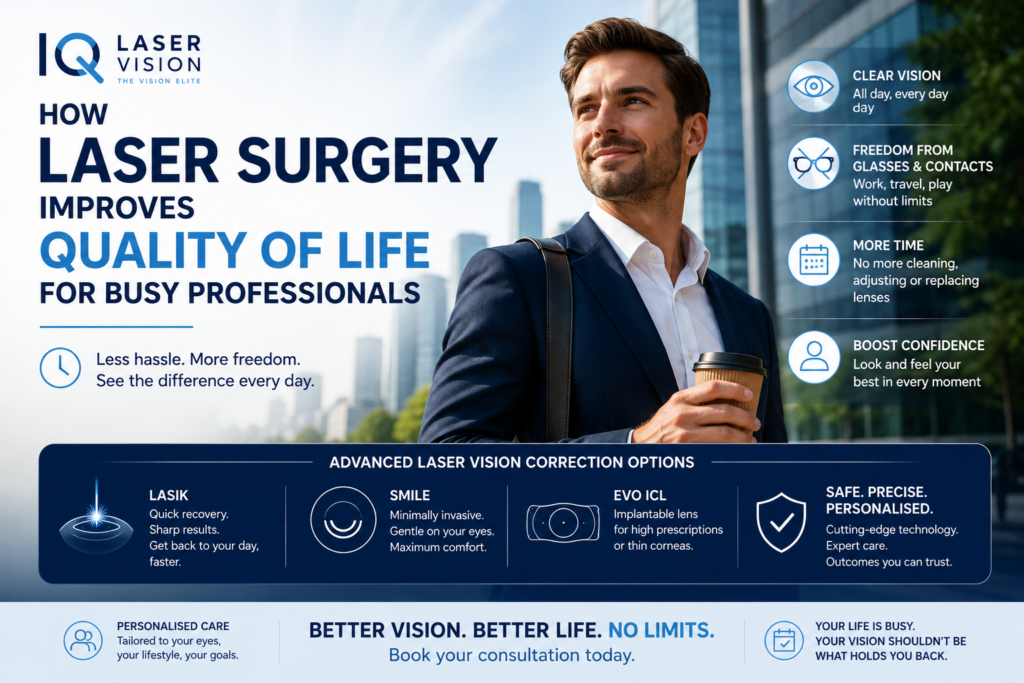
- Laser eye surgery eliminates the daily inconvenience of glasses and contact lenses, freeing up time and mental energy for busy professionals.
- Improved vision can directly enhance workplace performance, focus, and confidence.
- Active professionals benefit significantly, with no need for prescription sports eyewear or concerns about contacts in water or physical environments.
- Modern laser eye surgery is completed in a single session, with most patients fully recovered and back to their routine within a week.
- When viewed as a long-term investment, laser vision correction typically costs less over a lifetime than ongoing glasses and contact lens expenses.
For most people, imperfect vision becomes something they simply adapt to. Glasses and contact lenses become part of the daily routine, and the inconvenience they bring is quietly accepted as the cost of seeing clearly. But with laser eye surgery, that routine changes entirely. Suddenly, there are no lenses to find, no contacts to order, and no visual aids standing between you and your day.
For busy professionals in particular, the cumulative impact of this freedom is significant. The small daily friction of managing glasses and contact lenses adds up over time, in ways that affect not just convenience, but performance, confidence, and quality of life.
The Daily Toll of Glasses and Contacts on Professional Life
Most people who wear glasses will recognise the frustration of not having them when they are needed. Reading glasses are a particularly common culprit: the morning commute requires nothing, but the moment work begins, the absence of the right eyewear becomes an immediate problem. In an age where so many professionals spend the majority of their day in front of screens, the reliance on close-vision correction is constant.
Prolonged screen use also contributes to visual fatigue and, over time, can accelerate changes in prescription. For contact lens wearers, the experience brings its own set of challenges. Even low-level irritation from lenses, the persistent awareness of something sitting directly on the eye, can be a source of ongoing distraction during a demanding workday.
Laser eye surgery addresses these issues at their root. Rather than managing vision from the outside, it corrects the underlying refractive error permanently, removing the daily dependency on corrective eyewear altogether.
Professional Performance and Confidence
The benefits of clear, unaided vision extend beyond convenience. Many patients report a meaningful improvement in workplace performance following laser vision correction. The ability to read a spreadsheet, follow a presentation, or interpret a graph without straining, squinting, or asking a colleague for help has a direct impact on professional effectiveness.
There is also a less tangible but equally real benefit: confidence. No longer being defined by a reliance on glasses or the discomfort of contacts can shift how a person carries themselves at work. Feeling less dependent on physical aids, and more in control of something as fundamental as sight, contributes to a broader sense of capability and self-assurance.
You can read about how laser vision correction has changed the lives of real patients on our testimonials page.

Time-Saving Freedom: How Surgery Streamlines Your Routine
Beyond the workplace, laser eye surgery has a significant impact on how professionals engage with their lives outside of work. For those with active lifestyles, the limitations imposed by poor uncorrected vision can be a constant background concern.
Consider the practical challenges facing someone who surfs, sails, swims, or cycles after work:
- Standard glasses are too fragile and unstable for most physical activity.
- Prescription sports eyewear is expensive and still vulnerable to loss or damage.
- Contact lenses carry real risks in water environments, including exposure to chlorine in pools, and contaminants in open water.
- In fast-moving or high-stakes situations, such as a sailing race or open-water swim, compromised vision is not just inconvenient but a genuine safety risk.
Laser eye surgery removes all of these concerns in a single procedure. Whether the activity involves water, wind, physical contact, or simply moving too fast for glasses to be practical, clear unaided vision means one less variable to manage.
Safety is also worth considering seriously. In dynamic environments, whether on a road, on the water, or in a competitive sporting context, the speed of visual processing directly affects reaction time. Clear, unobstructed vision is not a luxury in these situations: it is a prerequisite for keeping yourself and others safe.
If you lead an active lifestyle and are weighing up which procedure best suits your needs, our vision correction self-test is a helpful starting point. Options such as SMILE and PRK may be particularly relevant for patients who want to eliminate flap-related risk in high-impact environments.
Laser Eye Surgery as a Long-Term Investment
One of the most common reasons professionals hesitate before pursuing laser eye surgery is cost. It is true that there is an upfront investment involved, but when weighed against the cumulative lifetime expense of glasses, contact lenses, lens solutions, and regular eye examinations, the calculation often favours surgery.
Frames, prescription lenses, and contact lens supplies can easily amount to several hundred dollars per year. Over a decade, that figure can significantly exceed the one-time cost of laser vision correction. Unlike ongoing eyewear expenses, laser eye surgery is typically a single procedure with lasting results.
For those for whom the upfront cost is a consideration, flexible financing options are available at IQ Laser Vision, including payment plans and 0% interest financing for qualifying patients, making the investment more accessible regardless of budget.
The Minimal Downtime of Modern Laser Eye Surgery
For many professionals, the concern that holds them back from laser eye surgery is not the procedure itself but the anticipated disruption to their schedule. The reality is far less daunting than most expect.
Modern laser eye surgery is typically completed within an hour. Patients go home the same day and, depending on the procedure, many notice meaningfully improved vision within 24 to 48 hours. Most patients are fully recovered and back to their normal professional routine within a week.
Procedure options vary in their recovery timelines:
- LASIK and SMILE: Most patients return to work within one to two days, with rapid initial visual recovery.
- PRK and LASEK: Recovery takes slightly longer, typically around one week, but these procedures are often preferred for patients with thin corneas or active lifestyles.
- EVO ICL: Recovery is similarly quick, with minimal surface disruption as the cornea is left untouched.
If downtime has been the barrier preventing you from moving forward, it is worth speaking with one of our ophthalmologists about which procedure would involve the least disruption for your specific situation. You can also explore our full range of vision correction procedures or contact us directly to book a consultation and take the first step toward lasting visual freedom.
Frequently Asked Questions
How quickly can I return to work after laser eye surgery?
Recovery time depends on the procedure. LASIK and SMILE patients typically return to desk-based work within one to two days. PRK and LASEK patients generally need around one week before resuming normal professional activities. Most people find the disruption to their routine is far shorter than they anticipated, and the long-term benefits far outweigh the brief recovery period.
Is laser eye surgery worth it for someone with a busy professional lifestyle?
For most professionals, laser eye surgery offers a meaningful improvement in daily convenience, workplace performance, and overall quality of life. Eliminating the ongoing management of glasses and contact lenses saves time, reduces distraction, and removes a source of low-level daily friction. When considered as a long-term investment rather than an upfront cost, it is often more economical than a lifetime of eyewear expenses.
Can I have laser eye surgery if I am very active or play sport?
Yes, and for many active patients, laser eye surgery is particularly transformative. Procedures such as SMILE and PRK are especially well suited to those with active or high-impact lifestyles, as they do not create a corneal flap and therefore carry no flap-related risk from physical contact or water exposure. A consultation with an ophthalmologist will identify which procedure best suits your activity level and eye anatomy.
How long do the results of laser eye surgery last?
Laser eye surgery produces permanent changes to the cornea that do not wear off. For the vast majority of patients, results are long-lasting and stable. Some patients may experience minor changes in vision over time due to natural age-related changes to the eye, such as presbyopia after the age of 40, but this is unrelated to the procedure itself. Enhancement procedures are available in the small number of cases where a minor prescription change occurs after surgery.