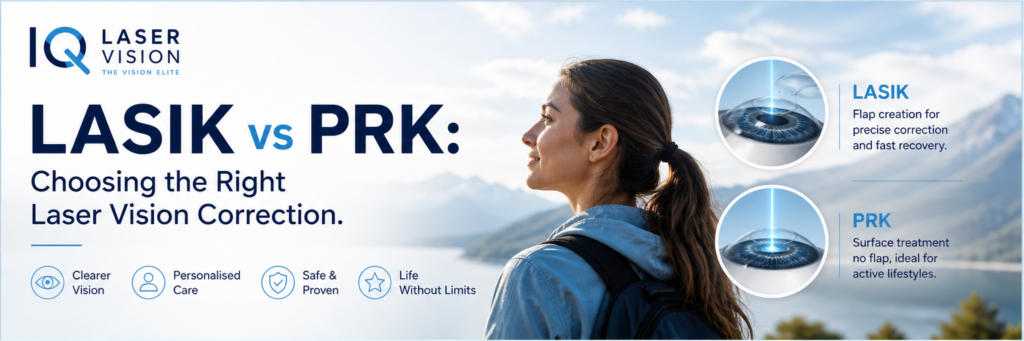
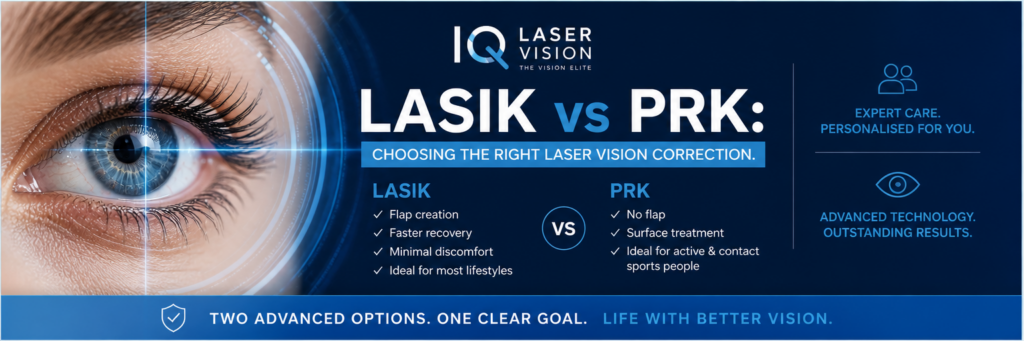
- LASIK creates a thin corneal flap to access and reshape the underlying tissue; PRK removes the outer epithelial layer entirely, with no flap created.
- PRK is often the preferred option for patients with thin corneas, irregular corneal surfaces, or those in high-impact professions or contact sports.
- LASIK offers a significantly faster recovery, with most patients achieving clear vision within 24 to 48 hours; PRK recovery takes several weeks to fully stabilise.
- Long-term visual outcomes are comparable between the two procedures, despite the difference in recovery experience.
- A comprehensive eye examination is essential to determine which procedure is the safer and more effective choice for your individual eye anatomy.
If you are considering laser vision correction, LASIK is likely the first procedure that comes to mind. It is widely known, highly effective, and has helped millions of people achieve clear vision without glasses or contact lenses. However, it is not the only option available. PRK (photorefractive keratectomy) is another proven laser procedure that continues to play an important role in modern eye care, particularly for patients who are not ideal LASIK candidates.
While both LASIK and PRK are designed to correct common refractive errors including nearsightedness, farsightedness, and astigmatism, they differ in how they treat the cornea and what recovery involves. Understanding the differences between LASIK vs PRK surgery will help you make a confident, informed decision. This guide breaks down how each procedure works, who each is best suited for, and what to expect throughout the process.
What is PRK and How Does it Differ From LASIK?
PRK is one of the earliest forms of laser vision correction and remains a trusted clinical option today. Like LASIK, it uses a laser to reshape the cornea so that light focuses more accurately on the retina. The key difference lies in how the surgeon accesses the corneal tissue.
- LASIK: A thin flap is created on the surface of the cornea. The flap is lifted, the underlying tissue is reshaped with a laser, and the flap is then repositioned. The eye begins healing almost immediately.
- PRK: No flap is created. Instead, the outermost layer of the cornea, known as the epithelium, is removed entirely to expose the treatment area. After laser reshaping is complete, the epithelium naturally regenerates over the following days.
Because PRK avoids flap creation, it preserves more of the cornea’s overall structural integrity. This distinction is central to why PRK is often recommended for specific patient profiles, particularly those who may not be clinically suitable for LASIK.
LASIK vs PRK: Procedure Comparison Table
| Feature | LASIK | PRK |
|---|---|---|
| Corneal access method | Flap creation | Epithelium removal (no flap) |
| Laser used | Femtosecond + excimer | Excimer laser only |
| Corneal tissue preserved | Less (flap plus reshaping) | More (surface treatment only) |
| Suitable for thin corneas | Often not suitable | Yes |
| Flap-related risk | Small ongoing risk | None |
| Initial recovery | 24 to 48 hours | Several days to weeks |
| Full visual stabilisation | Days to weeks | Several weeks to months |
| Discomfort during recovery | Mild | Moderate (while epithelium regenerates) |
| Long-term visual outcomes | Excellent | Comparable to LASIK |
| Suited to high-impact lifestyles | With caution | Yes (no flap to dislodge) |
Why PRK is Often the Best Choice for Thin Corneas
One of the most common clinical reasons a surgeon may recommend PRK over LASIK is insufficient corneal thickness. LASIK requires enough corneal tissue to safely create a flap and perform laser reshaping beneath it. If the cornea is too thin, removing that additional tissue risks compromising the structural stability of the eye.
PRK removes this concern by treating the corneal surface without flap creation, allowing surgeons to preserve more tissue overall. This makes it a safer option for patients with:
- Naturally thin corneas that cannot safely support LASIK
- Irregular corneal shapes or subtle surface abnormalities
- Corneal profiles that fall outside the safe parameters for flap-based procedures
By working directly on the outer corneal layer, surgeons can address surface irregularities more effectively without the added complexity of flap creation. While PRK involves a longer recovery period, long-term visual outcomes are comparable to LASIK, making it a strong and well-established alternative for patients with these anatomical considerations. If you are unsure whether your corneas are suitable for either procedure, our vision correction self-test is a useful first step before booking a formal consultation.
Comparing Recovery Times: What to Expect After PRK vs LASIK
Recovery is one of the most significant practical differences between PRK and LASIK, and it is an important factor for many patients when deciding between the two.
LASIK Recovery
- Most patients notice improved vision within 24 to 48 hours of the procedure.
- Discomfort is typically mild and short-lived.
- The majority of patients return to work and normal daily activities within one to two days.
PRK Recovery
- The epithelium must regenerate after removal, which typically takes several days.
- During this initial phase, patients may experience discomfort, light sensitivity, and blurred vision.
- Visual clarity improves gradually over several weeks, with full stabilisation often taking one to three months.
While the longer PRK recovery can be a drawback for patients with demanding schedules, it is important to keep in mind that the final visual outcomes are equivalent to LASIK in terms of clarity and quality. Patients considering PRK should plan for a period of downtime and a more gradual return to normal activities. Many find that the clinical benefits of PRK, particularly the elimination of flap-related risk, outweigh the temporary inconvenience of the longer healing process.
PRK vs LASIK: Which is Better for High-Impact Lifestyles?
Lifestyle is a significant factor when choosing between LASIK vs PRK surgery, particularly for patients who participate in contact sports, high-impact activities, or physically demanding professions.
Because LASIK involves creating a corneal flap, there is a small but ongoing risk that the flap could be dislodged or affected by trauma, even years after the procedure. For the majority of patients this risk is very low, but it is a genuine clinical consideration for:
- Athletes competing in contact sports such as martial arts, boxing, or rugby
- Military personnel or law enforcement officers
- Workers in environments where eye trauma or physical impact is more likely
PRK eliminates this concern entirely. Once the corneal surface has fully healed, there is no residual flap and therefore no associated long-term risk of displacement. PRK may also be better suited to individuals who regularly work in dry, dusty, or challenging environments, such as construction sites or outdoor settings, where ongoing corneal surface stability is important.
For patients who prioritise long-term durability and peace of mind in demanding conditions, PRK is often the clinically preferred option. You are also welcome to review the experiences of patients who have undergone vision correction with our team on our testimonials page.
Choosing the Right Procedure for Your Unique Eye Anatomy
Ultimately, the decision between LASIK vs PRK surgery comes down to your individual eye anatomy, clinical suitability, and personal priorities. Both procedures are safe, effective, and capable of delivering excellent long-term results, but they are not interchangeable, and the right choice varies from patient to patient.
A comprehensive eye examination is the essential first step. During this evaluation, your ophthalmologist will assess:
- Corneal thickness and overall structural integrity
- Corneal surface shape and topography
- Prescription strength and stability
- General eye health and any pre-existing conditions
Your lifestyle, occupation, and expectations should also form part of the discussion. If you are looking for the fastest possible recovery and meet the anatomical criteria for LASIK, it may be the more convenient choice. If you have thin corneas, lead an active or high-impact lifestyle, or want to eliminate flap-related risk entirely, PRK is likely the stronger fit.
It is also worth noting that LASIK and PRK are not the only procedures available. Patients who are unsuitable for either corneal laser procedure may benefit from alternatives such as EVO ICL or Refractive Lens Exchange (RLE), depending on their prescription and clinical profile. For authoritative guidance on laser vision correction procedures, the American Academy of Ophthalmology provides trusted and comprehensive patient resources.
Choosing the right procedure means finding the right balance between safety, effectiveness, and lifestyle suitability. With the guidance of an experienced eye care professional, you can identify the option that best supports your long-term vision goals. To take the next step, contact IQ Laser Vision and book your personalised consultation today.
Frequently Asked Questions: LASIK vs PRK Surgery
What is the main difference between LASIK and PRK?
The primary difference is how each procedure accesses the cornea. LASIK creates a thin flap on the corneal surface, which is lifted to allow laser reshaping underneath before being repositioned. PRK removes the outermost epithelial layer entirely, with no flap created, and the epithelium regenerates naturally over the following days. Because PRK does not create a flap, it preserves more corneal tissue and eliminates any flap-related risk.
Which procedure has a faster recovery: LASIK or PRK?
LASIK offers a significantly faster recovery. Most patients notice improved vision within 24 to 48 hours and return to normal activities within one to two days. PRK involves a longer healing process because the epithelium must regenerate after removal. Functional vision typically returns within one to two weeks, with full visual stabilisation taking one to three months. Despite the difference in recovery, the long-term visual outcomes of both procedures are comparable.
Is PRK better than LASIK for athletes or active patients?
For patients with active lifestyles or those in contact sports, military service, or physically demanding roles, PRK is often the preferred option. Because no corneal flap is created, there is no risk of flap dislodgement from trauma or physical impact, either immediately after surgery or in the long term. Once fully healed, the corneal surface is structurally intact and durable, making PRK a more suitable choice for patients in high-impact environments.
Who is PRK recommended for over LASIK?
PRK is typically recommended for patients with thin corneas that cannot safely support flap creation, those with irregular or abnormal corneal surface shapes, individuals with active or high-impact lifestyles, and patients who wish to eliminate flap-related complications entirely. In all of these cases, PRK offers a clinically safer path to vision correction with long-term outcomes equivalent to LASIK.