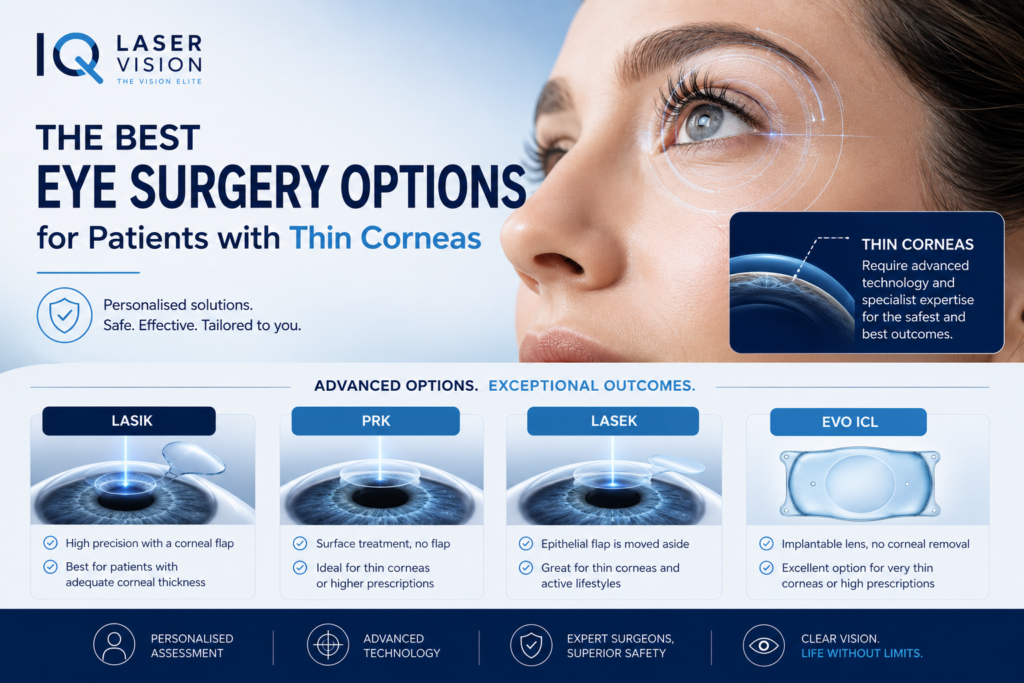
- Corneal thickness is a critical factor in determining candidacy for laser eye surgery, as each procedure requires a minimum amount of tissue to preserve the cornea’s structural integrity.
- Patients with thin corneas who are not suitable for LASIK may still be strong candidates for PRK, LASEK, or implantable lens procedures.
- PRK and LASEK treat the corneal surface without creating a flap, removing less overall tissue and making them safer options for thinner corneas.
- EVO ICL bypasses the cornea entirely by implanting a biocompatible lens inside the eye, making it an excellent alternative for patients unsuitable for any surface laser procedure.
- A comprehensive eye examination is essential to determine which procedure is safest and most effective for your individual eye anatomy.
Eye surgery is an increasingly popular solution for those looking to address the root cause of their vision problems, rather than spending a lifetime managing glasses or contact lenses and adjusting prescriptions over time. However, eyes and their components do not come in standard sizes. Like all parts of the body, they vary considerably in shape, structure, and dimension.
One of the most significant anatomical variables when it comes to laser vision correction is corneal thickness. While a thin cornea does not prevent you from achieving clear vision through surgery, it does require careful consideration of which procedure is most appropriate and safe. The good news is that several effective options exist, and having thin corneas is not a barrier to successful vision correction.
Why Corneal Thickness is Critical for Laser Eye Surgery
Corneal thickness is one of the most important factors assessed when evaluating a patient’s suitability for laser eye surgery. Every laser vision correction procedure involves removing or reshaping a small amount of corneal tissue, and a sufficient amount must remain afterward to preserve the cornea’s structural integrity and its ability to function correctly within the eye.
A relatively thin cornea can be entirely healthy and functional in its natural state. The challenge arises when that cornea needs to be reshaped to correct a refractive error, as doing so makes it thinner still. While the quantities of tissue involved are extremely small, if the cornea is unusually thin to begin with, the margin for safe removal is reduced, and the choice of procedure must be made with particular care.
Several factors can influence corneal thickness, including:
- Age: Corneal thickness can change gradually over time.
- Ethnicity: Population-level differences in average corneal thickness are well documented.
- Diabetes: Certain systemic conditions can affect corneal structure.
- Previous eye surgery: Any prior procedure that involved corneal tissue will have reduced the available thickness for future treatment.
If a thin cornea rules out LASIK, alternative procedures such as PRK or EVO ICL can often provide an equally effective result. A thin cornea is a characteristic, not a defect, and it can be successfully accommodated with the right approach.
When Traditional LASIK is Not an Option
In standard LASIK surgery, a femtosecond laser creates a thin flap on the surface of the cornea. This flap is lifted while the underlying tissue is reshaped with an excimer laser, then repositioned to act as a natural protective layer during healing. The reshaped tissue integrates with the flap without stitches, and recovery is typically rapid.
LASIK is suitable for the majority of patients and remains one of the most widely performed elective surgical procedures in the world. However, because it involves both flap creation and tissue reshaping, it requires a minimum corneal thickness that not every patient has. For those who fall below this threshold, the risks associated with further thinning make LASIK unsuitable, and an alternative must be considered.
Fortunately, the alternatives available today are highly effective and, in some respects, offer advantages of their own.
Option 1: Surface Ablation Procedures (PRK and LASEK)
PRK (photorefractive keratectomy) is one of the original forms of laser vision correction and remains a trusted option, particularly for patients with thinner corneas. Rather than creating a flap, PRK removes only the outermost layer of the cornea, known as the epithelium, to access the tissue beneath. The laser then reshapes this underlying tissue to correct the refractive error. After the procedure, the epithelium regenerates naturally over several days.
Because PRK does not involve flap creation, it removes less overall corneal tissue than LASIK, making it a safer option for patients where preserving corneal thickness is a priority. It also eliminates any flap-related risk, which is an additional advantage for patients with active lifestyles or those in contact sports.
LASEK is a closely related surface procedure that follows a similar principle. The differences between PRK, LASEK, and LASIK are relatively minor in clinical terms, and some surgeons favour one over the others based on individual patient profiles. All three procedures are capable of producing excellent long-term visual outcomes.
One practical difference to be aware of is recovery comfort. With PRK and LASEK, where no flap is present, a temporary soft contact lens is placed over the cornea to protect the surface and support a more comfortable recovery while the epithelium heals. Recovery takes slightly longer than LASIK, typically around one week before patients can safely resume driving and most daily activities. Some light sensitivity and blurred vision during this initial period is normal.
Option 2: Implantable Collamer Lenses (EVO ICL)
For patients whose corneas are too thin for any surface laser procedure, EVO ICL (Implantable Collamer Lens) offers a highly effective alternative that does not involve the cornea at all.
EVO ICL is defined as a procedure in which a thin, flexible lens made from collamer, a biocompatible material combining collagen and polymer, is implanted inside the eye, positioned behind the iris and in front of the natural lens. Because the cornea is left entirely untouched, corneal thickness is not a limiting factor.
Key advantages of EVO ICL for thin cornea patients include:
- No corneal tissue removed: The procedure completely bypasses the cornea, making it suitable regardless of corneal thickness.
- Wide prescription range: EVO ICL can correct moderate to severe myopia that may fall outside the safe limits of laser-based procedures.
- Lower dry eye risk: Because the corneal surface and its nerves are undisturbed, EVO ICL carries a significantly lower risk of post-operative dry eye symptoms.
- Reversibility: Unlike laser procedures that permanently alter the cornea, the EVO ICL implant can be removed or replaced if your prescription changes or new technologies become available.
EVO ICL can be thought of as a highly sophisticated internal lens correction, preserving your eye’s natural structure while adding a precisely calibrated corrective element inside it.
Comparing Thin Cornea Surgery Options
| Procedure | Corneal tissue removed | Suitable for thin corneas | Flap created | Reversible | Recovery time |
|---|---|---|---|---|---|
| LASIK | Yes (flap + reshaping) | Not always | Yes | No | 24 to 48 hours |
| PRK | Yes (surface only) | Often suitable | No | No | Around one week |
| LASEK | Yes (surface only) | Often suitable | No | No | Around one week |
| EVO ICL | No | Yes | No | Yes | Several days |
Safety, Recovery, and Visual Outcomes
All of the procedures outlined above have well-established safety records and a high rate of patient satisfaction. The right choice for any individual depends on their specific anatomy and clinical profile, but none of these options should be considered a compromise.
- PRK and LASEK: Recovery typically takes around one week, after which most patients can drive and resume normal activities. Some discomfort, light sensitivity, and temporary blurring is normal during the initial healing phase as the epithelium regenerates. Long-term visual outcomes are comparable to LASIK.
- EVO ICL: Recovery is relatively quick, with many patients noticing improved vision within days. Because the cornea is untouched, there is minimal surface disruption during healing. The implanted lens is designed to remain in place indefinitely but can be replaced if needed, offering ongoing flexibility.
In all types of vision correction surgery, a high proportion of patients report excellent satisfaction with their outcomes. You can read about the experiences of real IQ Laser Vision patients on our testimonials page.
For authoritative clinical information on corneal health and laser eye surgery suitability, the American Academy of Ophthalmology provides comprehensive and trusted patient guidance.
Finding the Most Suitable Procedure for Your Unique Eyes
Because eyes vary so significantly in size, shape, and structure, a detailed pre-operative examination is essential before any procedure can be recommended. During this assessment, your eye specialist will evaluate factors including:
- Corneal thickness and topography
- Prescription strength and stability
- Overall eye health and any pre-existing conditions
- Lifestyle factors, including participation in contact sports or physically demanding activities
Lifestyle is a particularly relevant consideration for thin cornea patients. Those who engage in high-impact activities such as boxing, wrestling, or martial arts, or who work in physically demanding environments, may benefit from a flap-free or cornea-sparing procedure regardless of corneal thickness, simply to eliminate any risk of surface disruption.
Our vision correction self-test is a useful starting point to begin assessing your suitability before booking a full consultation with one of our ophthalmologists. If you are also exploring broader vision correction options, our pages on SMILE and Refractive Lens Exchange (RLE) cover additional procedures that may be relevant depending on your age and prescription profile.
Having thin corneas is simply one characteristic of your unique eye anatomy. With the range of advanced procedures available today, it is not a barrier to achieving clear, lasting vision. To find out which option is right for you, contact IQ Laser Vision and book your personalised consultation.
Frequently Asked Questions: Eye Surgery for Thin Corneas
Can I have laser eye surgery if I have thin corneas?
Yes, in many cases. While thin corneas may rule out traditional LASIK, alternative procedures such as PRK and LASEK treat the corneal surface without creating a flap, removing less tissue overall and making them safer options for thinner corneas. For patients whose corneas are too thin for any laser-based procedure, EVO ICL implants a corrective lens inside the eye without touching the cornea at all. A comprehensive eye examination will determine which option is appropriate for you.
Why is LASIK not suitable for thin corneas?
LASIK involves creating a corneal flap and reshaping the tissue beneath it, which requires a minimum corneal thickness to ensure structural stability remains after the procedure. If the cornea is too thin, removing additional tissue risks compromising its integrity and ability to function correctly. Procedures such as PRK, LASEK, and EVO ICL are designed to address this limitation while still achieving effective vision correction.
What is the safest eye surgery option for thin corneas?
The safest option depends on the degree of corneal thinning and your overall eye health. PRK and LASEK are well-established surface procedures that preserve more corneal thickness than LASIK and have no flap-related risks. EVO ICL is considered the most tissue-conservative option because it does not interact with the cornea at all. An ophthalmologist will assess your specific anatomy and recommend the procedure that offers the best balance of safety and visual outcome for your individual case.
Will thin corneas affect my long-term visual outcomes after surgery?
Not significantly. When the appropriate procedure is selected based on your corneal profile, long-term visual outcomes for thin cornea patients are comparable to those achieved by patients with average corneal thickness. PRK, LASEK, and EVO ICL all have strong track records of delivering clear, stable vision over the long term. The key is ensuring the correct procedure is chosen through thorough pre-operative assessment.